

Stainless steel sheet and plate – 2B, BA, brushed, tread plate, perforated and cut to size
We supply stainless steel sheet in two ways: as full sheets from the catalogue or cut to size, priced online in our calculator. Full sheets come in 1000 × 2000, 1250 × 2500 and 1500 × 3000 mm, in grades 304, 316, 316L, 321 and 430, with 2B, 2R (BA), brushed and 1D finishes. We also stock tread plate and perforated sheet in grade 304. You can price cut-to-size sheet up to 1000 × 1450 mm yourself in the calculator. We currently deliver within Poland only and all prices are in Polish złoty (PLN). You can also collect your order in person from our branches in Dębica or Mielec (Poland) – free of charge, paid in advance.
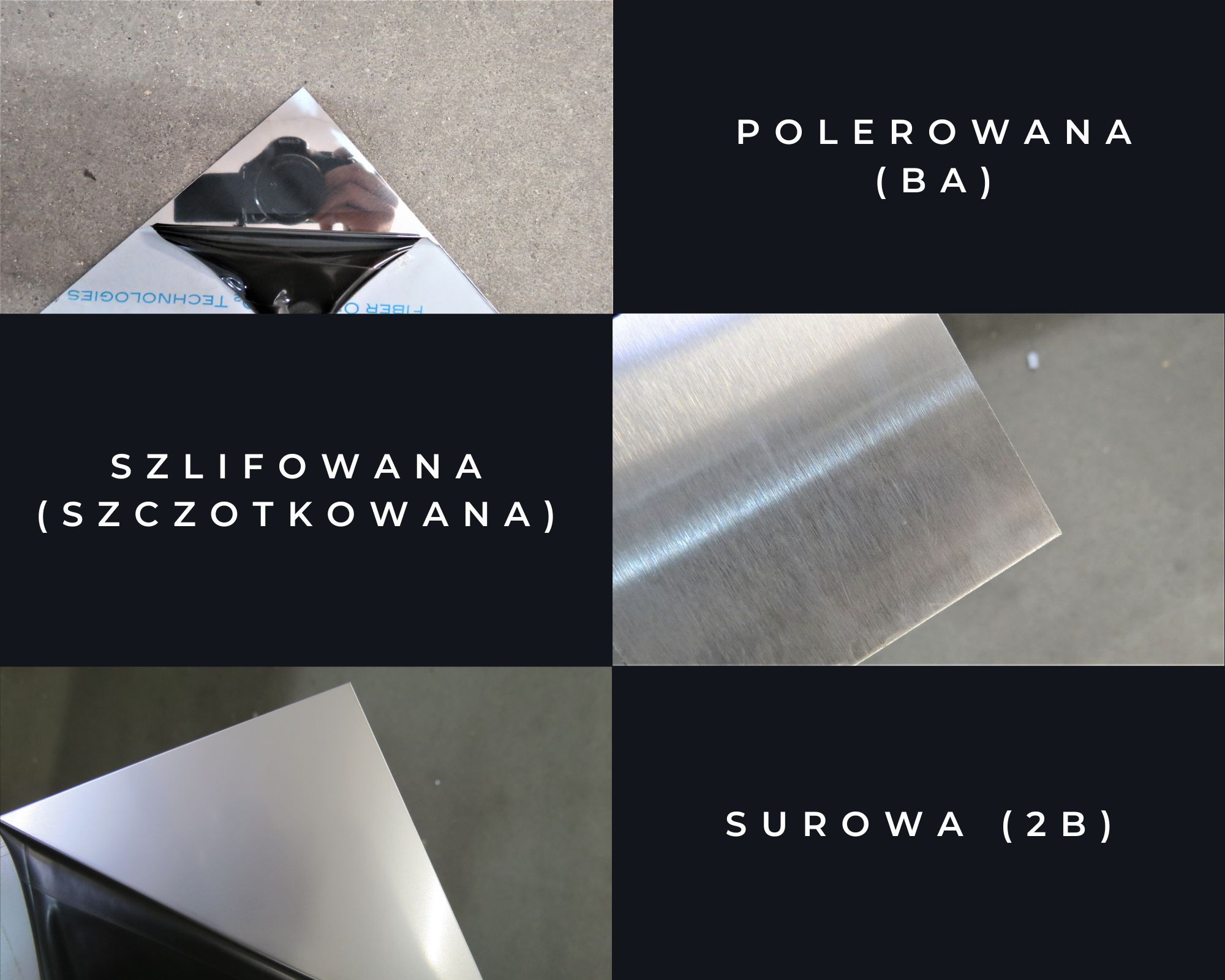
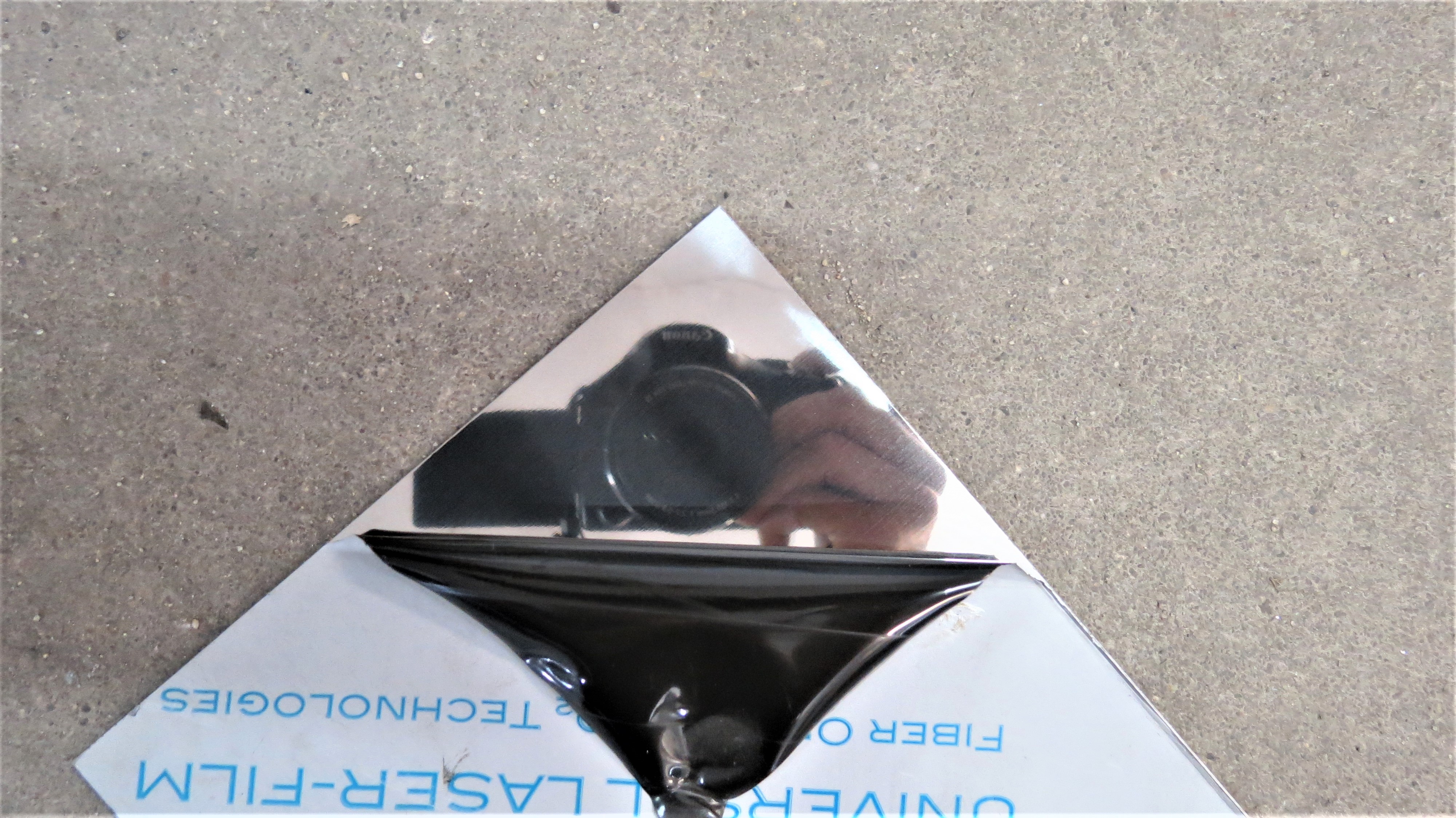
Our range of stainless steel sheet
Our range falls into four groups: plain sheet, tread plate, perforated and decorative sheet, and cut-to-size sheet from the calculator. Catalogue thicknesses run from 0.3 to 25 mm. Most plain sheets are supplied with a protective film on one side. The Polish product name tells you which: ‘+ folia’ means with film, ‘bez folii’ means without.
| Group | Grade | Thickness range | Sheet sizes |
|---|---|---|---|
| Plain sheet | 304 (1.4301), 304/304L, 316 (1.4401), 316L (1.4404), 321 (1.4541), 430 (1.4016) | 0.3–25 mm | 1000 × 2000, 1250 × 2500, 1500 × 3000 mm |
| Tread plate | 304 | 3 and 4 mm | 1000 × 2000, 1250 × 2500, 1500 × 3000 mm |
| Perforated sheet | 304 | 0.8, 1, 1.5, 2, 3 mm | mostly 1000 × 2000 mm |
| Decorative sheet | 304 (BA finish) | 0.8 mm | 1250 × 2500 mm |
| Cut to size (calculator) | 304, 316, 430 | 0.5–6 mm (see the list of thicknesses below) | from 100 × 100 to 1000 × 1450 mm |
Grade 430 is listed in thicknesses from 0.5 to 3 mm, mostly in BA. Product names in our catalogue are in Polish. The shop search recognises the English terms ‘sheet’ and ‘plate’, the finish codes 2B and BA, and ‘acid-resistant’ for grade 316. For brushed sheet, use the Polish word szlif (or szczotkowana). For example, try ‘sheet 1 mm szlif 304’ (1 mm brushed 304 sheet) or ‘blacha kwasoodporna 2 mm’ (2 mm grade 316 sheet).
Stainless steel tread plate and perforated sheet
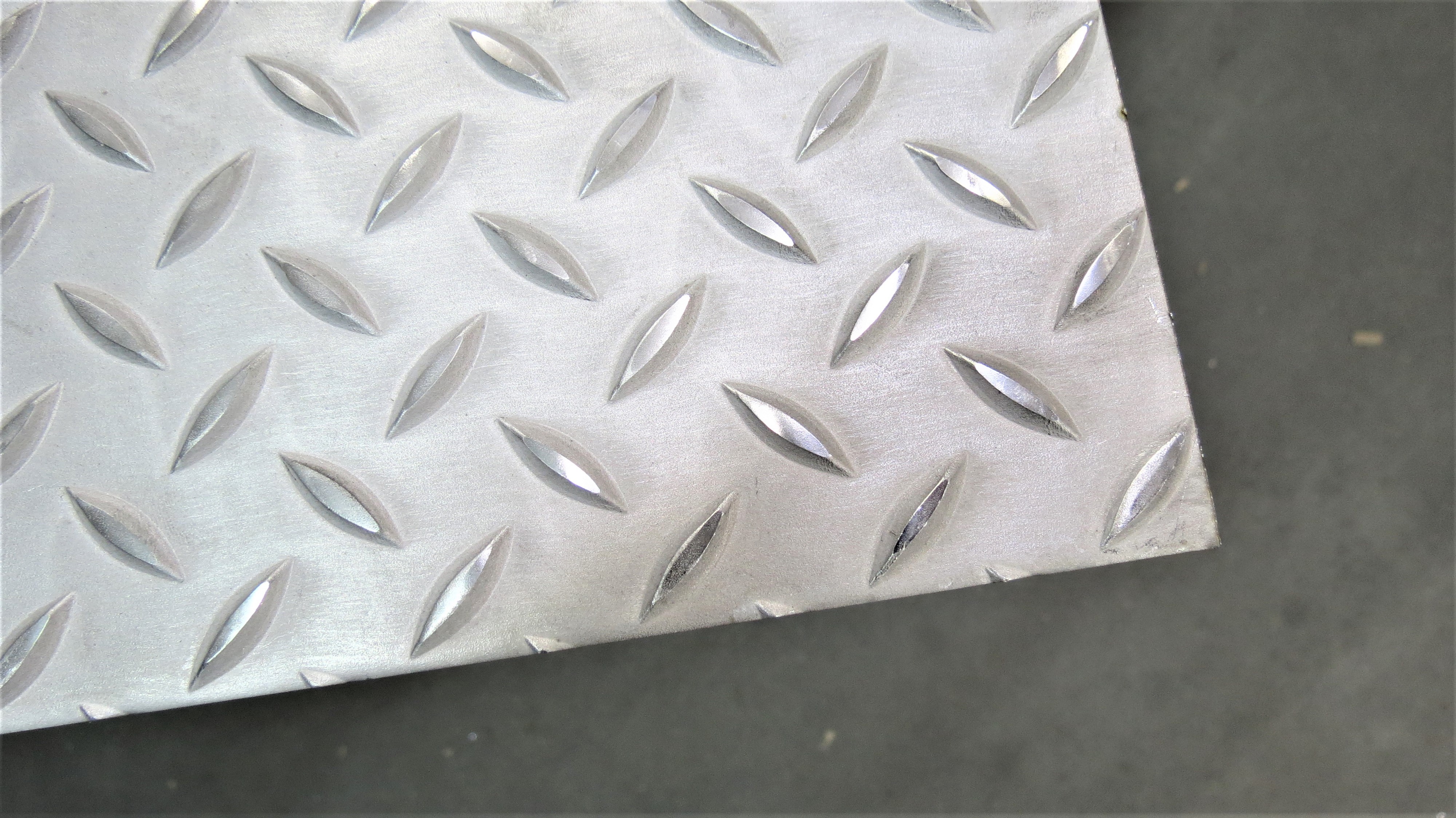
Our stainless tread plate (chequer plate) is grade 304, 3 and 4 mm thick, in 1000 × 2000, 1250 × 2500 and 1500 × 3000 mm sheets. In the surface finish table of EN 10088-2, patterned chequer plate for flooring is designated 1M. The rolled pattern stiffens the sheet and hides scratches and dents better than a plain surface. For any specific item, customer service will confirm the pattern type, the height of the raised pattern and whether the stated thickness includes it.
Our perforated stainless steel sheet is grade 304, in 0.8, 1, 1.5, 2 and 3 mm, almost all in 1000 × 2000 mm sheets. It is available with round (RV) and square (QG) holes in a range of sizes, such as RV 5-8, RV 8-12 and QG 10-15. Perforation designations are set out in DIN 24041 and ISO 7806. As a rule, ‘RV 5-8’ means 5 mm round holes at an 8 mm pitch, and ‘QG 6-9’ means 6 × 6 mm square holes at a 9 mm pitch. The letter ‘v’ denotes a staggered (60°) pattern and ‘g’ a straight, in-line (90°) pattern. This is a general guide to the designations only, so please confirm the details of a particular sheet with customer service before you order.
Blacha ryflowana 3x1000x2000 gat. 304
Only 3 pcs left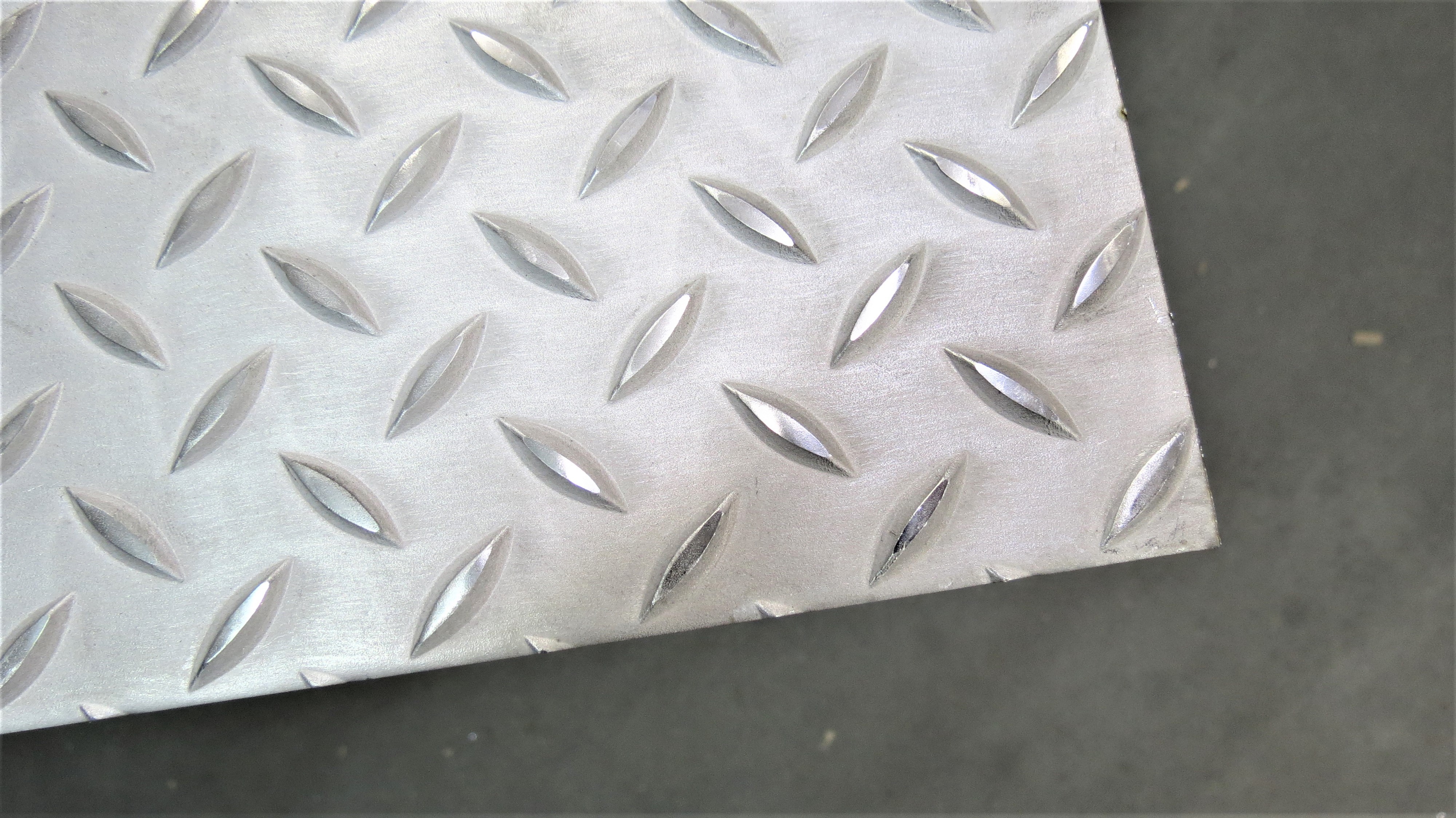
Blacha ryflowana 3x1250x2500 gat. 304
Only 2 pcs leftBlacha ryflowana 4x1250x2500 gat. 304
Only 1 pcs leftBlacha dekoracyjna 0,8x1250x2500 BA gat. 304
Only 1 pcs leftBlacha perforowana 1,5x1000x2000 QG 10-15 gat. 304
Only 2 pcs leftBlacha perforowana 1,5x1000x2000 RV 10-20 gat. 304
Only 2 pcs leftBlacha perforowana 1,5x1000x2000 RV 12-16 gat. 304
Only 3 pcs leftBlacha perforowana 1,5x1000x2000 RV 3-5 gat. 304
Only 2 pcs leftBlacha perforowana 1,5x1000x2000 RV 4-6 gat. 304
Only 2 pcs leftBlacha perforowana 1,5x1000x2000 RV 5-8 gat. 304
Only 1 pcs leftBlacha perforowana 1,5x1000x2000 RV 8-12 gat. 304
In stock · 5 pcs304 vs 316 vs 430 stainless steel sheet – which grade to choose
Specify the grade for the service environment, not for appearance. The corrosion resistance class (CRC) comes from EN 1993-1-4 (Eurocode 3): the higher the class, the more aggressive the conditions the steel will withstand. PRE (pitting resistance equivalent number, also written PREN) indicates resistance to pitting corrosion – the higher the value, the better the resistance.
| Grade (AISI / EN) | Type | Magnetic | PRE | CRC | Typical uses |
|---|---|---|---|---|---|
| 304 / 1.4301 | austenitic | practically non-magnetic | 18 | II | cladding, handrails, kitchen and food equipment, tanks, less demanding outdoor environments |
| 304L / 1.4307 | austenitic, low carbon | practically non-magnetic | – | II | as 304, for welding thicker sections – less carbide precipitation and better resistance to intergranular corrosion |
| 316 / 1.4401 | austenitic, with molybdenum | practically non-magnetic | 24 | III | coastal and heavily industrial locations, many acidic environments |
| 316L / 1.4404 | austenitic, with molybdenum, low carbon | practically non-magnetic | 24 | III | as 316, for welding thicker sections |
| 321 / 1.4541 | austenitic, titanium-stabilised | practically non-magnetic | – | II | titanium stabilisation makes it better suited to welding heavy sections and to heat treatment in the 550–850 °C range (lower risk of intergranular corrosion) |
| 430 / 1.4016 | ferritic | magnetic | 16 | I | interiors, mildly corrosive environments |
Under EN 10088-2, cold-rolled 1.4301 sheet has a minimum 0.2% proof strength (Rp0.2) of 230 MPa, a tensile strength (Rm) of 540–750 MPa and a minimum elongation (A) of 45%. In Poland, 316 and 316L are sold as ‘kwasoodporna’ (literally ‘acid-resistant’) steel, because molybdenum improves their resistance in many acidic environments. The name does not mean the steel will not corrode under any conditions. At high chloride levels and in marine splash zones, more highly alloyed grades are required. For a full comparison, see our page on stainless steel grades.
Finishes: 2B, 1D, 2R (BA) and brushed stainless steel sheet
EN 10088-2 designates surface finishes by a number and a letter. The number indicates the process route: 1 for hot rolled, 2 for cold rolled. The letter describes the subsequent surface treatment. 2G, 2J, 2K and 2P are mechanical finishes.
| Designation | How it is produced | Appearance | Typical uses |
|---|---|---|---|
| 1D | hot rolled, annealed, pickled (descaled) | slightly rough, very low reflectivity | thicker sheet and plate, structural and non-decorative applications |
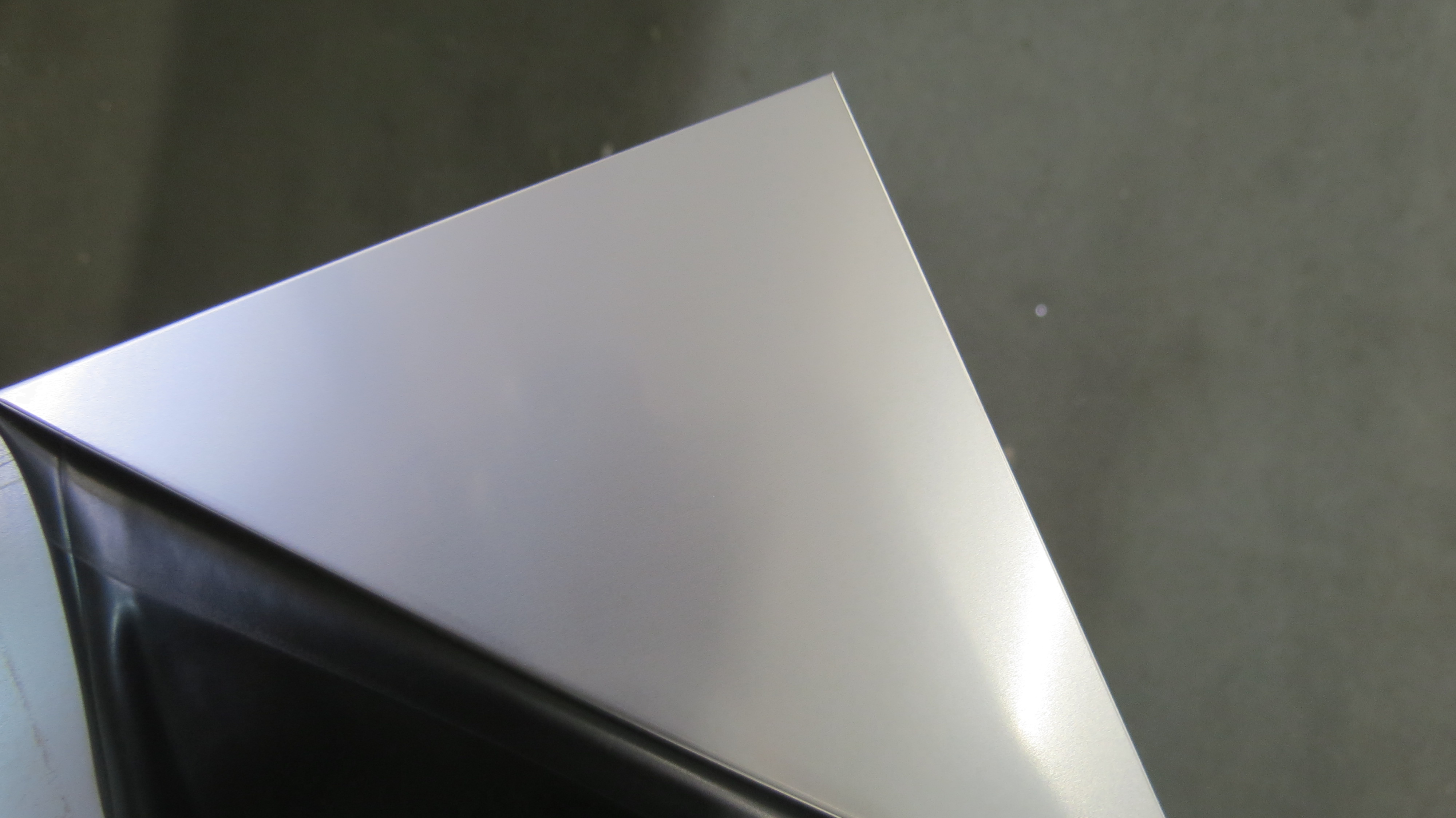
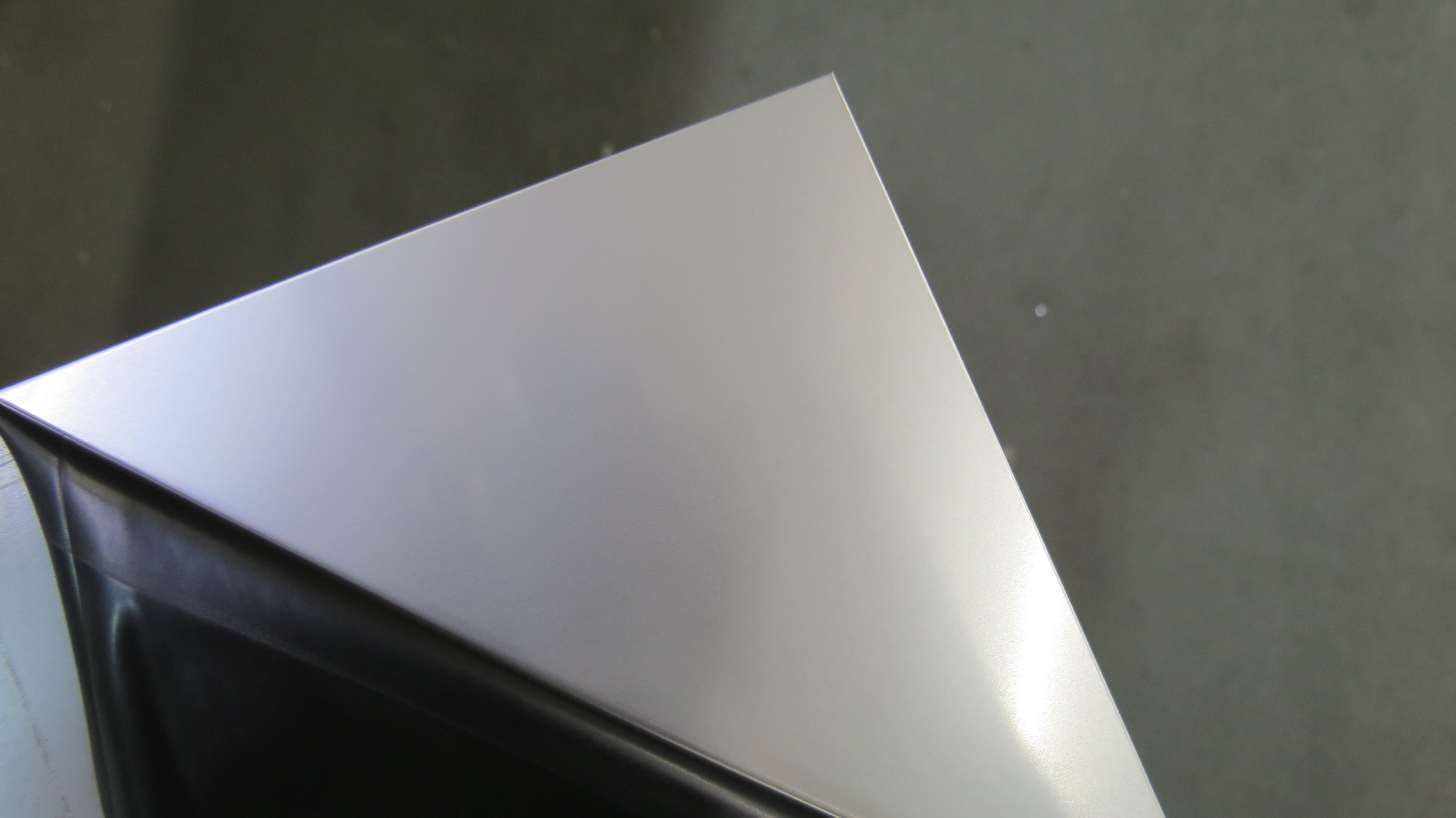
| 2B | cold rolled, annealed, pickled and skin passed (a light pass through polished rolls) | smooth, with a grey sheen | the most widely used finish, and the basis for brushed and polished finishes |
| 2R (commonly BA) | cold rolled with polished rolls, bright annealed in an oxygen-free atmosphere | highly reflective, with a clear reflected image | where gloss and easy cleaning matter – less likely than other mill finishes to retain dirt and moisture |
| 2G | mechanically ground | directional, low reflectivity, coarse grind | interiors |
| 2J | brushed or dull polished | directional, non-reflective | interiors |
| 2K | satin polished, transverse Ra below 0.5 µm | satin | external architectural and coastal applications |
| 2P | mechanically polished | mirror | decorative components with a mirror effect |
In our shop, the finish is shown in the product name and attributes. The Polish catalogue names are SUROWA (2B), POLER (BA – bright annealed, not mechanically polished), SZLIF / SZCZOTKOWANA (brushed), and 1D for heavier plate. Approximate catalogue thicknesses: 2B 0.3–8 mm, BA 0.5–3 mm, brushed 0.5–5 mm, 1D 4–25 mm. For mechanical finishes, the purchaser may specify the grit or surface roughness. Under EN 10088-2, a mechanical finish applies to one side of the sheet unless agreed otherwise. Customer service will confirm the grit of a particular brushed sheet and whether it is brushed on one side only. Need a different surface treatment? Just ask – our processing services are listed at jannierdzewny.pl/uslugi (in Polish). Read more on our page about stainless steel surface finishes.
Stainless steel sheet cut to size – online calculator
We cut sheet to your exact dimensions. In the cut-to-size sheet calculator, choose the material, grade, finish and thickness, enter the dimensions in millimetres and the price is calculated instantly. The price of a cut sheet is based on its weight: dimensions × thickness × density × price per kg. Below the price, you can see the cost of courier delivery within Poland and the free collection option. The same calculator also handles mild steel and aluminium sheet.
| Calculator option | Thicknesses [mm] |
|---|---|
| 304, 2B | 0.5, 0.6, 0.8, 1, 1.5, 2, 3, 4 |
| 304, BA | 0.5, 0.6, 0.8, 1, 1.5, 2, 3 |
| 304, brushed | 0.5, 0.6, 0.8, 1, 1.5, 2, 3 |
| 304, 1D | 5, 6 |
| 316, 2B | 0.5, 0.6, 0.8, 1, 1.5, 2, 3 |
| 430 (listed as 430 / H17), BA | 0.5, 0.6, 0.8, 1, 1.5, 2, 3 |
- Shape: rectangle or square, minimum 100 × 100 mm.
- The standard maximum size is 1000 × 1450 mm. For some thicknesses the limit is lower, for example 900 × 900 mm for 4 mm 2B and 700 × 700 mm for 6 mm 1D. The calculator shows the limit when you make your selection.
- Lead time: up to 3 working days. Exception: grade 316 in 0.5 and 1.5 mm – 4 working days.
- A cut sheet with its longest side up to 1200 mm is sent as a standard courier parcel (up to 30 kg). Larger pieces, such as 1450 × 1000 mm, are sent by courier as a long-length item (up to 2 m).
- Bigger sheets, non-rectangular shapes, non-standard dimensions and larger quantities are quoted individually by email, usually within one working day. Non-rectangular shapes are laser cut.
Cut-to-size sheet is made to your specifications, so the right of withdrawal (returning goods without giving a reason) does not apply to it. See returns and complaints for details. Cutting tube, bar and sections to length is covered on our page about stainless steel cut to size.
Stainless steel sheet weight chart
Theoretical sheet weight = thickness × length × width × density. With dimensions in mm and density in kg/dm³, divide the result by 1,000,000. Densities to EN 10088-1: 304 – 7.9 kg/dm³, 316 and 316L – 8.0 kg/dm³, 430 – 7.7 kg/dm³. For example, a 1 × 1000 × 2000 mm sheet in grade 304 weighs approx. 15.8 kg, and a common 2 × 1000 × 2000 mm sheet approx. 31.6 kg. The values in the table are theoretical and rounded.
| Thickness [mm] | 304 [kg/m²] | 304 sheet 1000 × 2000 [kg] | 304 sheet 1250 × 2500 [kg] | 304 sheet 1500 × 3000 [kg] | 316/316L [kg/m²] | 430 [kg/m²] |
|---|---|---|---|---|---|---|
| 0.5 | 3.95 | 7.9 | 12.3 | 17.8 | 4.0 | 3.85 |
| 0.8 | 6.32 | 12.6 | 19.8 | 28.4 | 6.4 | 6.16 |
| 1 | 7.9 | 15.8 | 24.7 | 35.6 | 8.0 | 7.7 |
| 1.5 | 11.85 | 23.7 | 37.0 | 53.3 | 12.0 | 11.55 |
| 2 | 15.8 | 31.6 | 49.4 | 71.1 | 16.0 | 15.4 |
| 3 | 23.7 | 47.4 | 74.1 | 106.7 | 24.0 | 23.1 |
| 4 | 31.6 | 63.2 | 98.8 | 142.2 | 32.0 | – |
| 5 | 39.5 | 79.0 | 123.4 | 177.8 | 40.0 | – |
| 6 | 47.4 | 94.8 | 148.1 | 213.3 | 48.0 | – |
| 8 | 63.2 | 126.4 | 197.5 | 284.4 | 64.0 | – |
| 10 | 79.0 | 158.0 | 246.9 | 355.5 | 80.0 | – |
The table applies to plain sheet; customer service will confirm the weight of tread plate. For other sizes, use the ‘Weight calculator’ (linked in the shop header). The cut-to-size sheet calculator shows the weight of every cut piece.
Cutting, bending and welding stainless steel sheet
Outside the calculator, we cut sheet by oxygen-assisted laser cutting, nitrogen-assisted laser cutting, guillotine shearing and band sawing. Our guillotine shears stainless steel up to 4 mm thick, on sheets up to 3000 × 2500 mm – the quickest and most economical method. Our laser cuts stainless steel from 0.5 to 30 mm, on sheets up to 1500 × 3000 mm, from DXF, DWG or PDF files. Nitrogen-assisted laser cutting leaves a clean, bright edge that is ready for welding. Details of our laser cutting are on our services page (in Polish), and we will quote for cutting from your file once you send an enquiry using the form at the bottom of this page. Laser-cut edges can be sharp, and guillotined edges may need light deburring. See our page on cutting stainless steel for details.
- Bending: austenitic sheet (304, 316) needs about 50% more force than mild steel of the same thickness. Springback is compensated by overbending, typically by about 5°. We bend on a 175-tonne CNC press brake, with a bending length of up to 3000 mm – see bending stainless steel.
- Other sheet processing services – just ask. You will find the current list at jannierdzewny.pl/uslugi (in Polish).
- Welding: austenitic grades weld well by all common methods except oxyacetylene (gas) welding. For thicker sections, choose a low-carbon (L) grade. Remove heat tint (oxide) after welding, for example by pickling. The thermal expansion of austenitic grades is about 50% higher than that of ferritic grades, so the sheet distorts more during welding. On brushed sheet, allow for re-brushing the weld area to blend it in. Read more about welding stainless steel.
Our own fabrication work in stainless steel sheet includes commercial catering equipment (work tables, shelving units, worktops), containers, boxes, enclosures, cassettes and tanks. For tube, bar and fittings for the same project, see stainless steel tube, round bar and flat bar and balustrade components.
Common mistakes with stainless steel sheet
- Using 430 outdoors or where chlorides are present (road salt, sea air, swimming pools). It is a grade for interiors and mildly corrosive environments.
- Using 304 in coastal and heavily industrial locations. Choose 316 or 316L instead. At high chloride levels and in marine splash zones, even 316L is not enough – a more highly alloyed grade is required.
- Load-bearing structures and fasteners in indoor swimming pools. EN 1993-1-4 requires CRC III or IV for regularly cleaned components and CRC V for components that are not cleaned and for all fasteners. Grades 304 (CRC II) and 430 (CRC I) do not meet this, and 316 and 316L (CRC III) do not meet the requirements for components that are not cleaned or for fasteners. Select the steel together with the structural designer.
- Welding thick 304 sheet without considering 304L or 321 – this carries a risk of intergranular corrosion.
- Cleaning with steel wool, carbon steel abrasives or chloride-based cleaners. The same applies to cutting and bending with tools also used on mild steel – iron particles left on the surface can cause rust staining. Use tools reserved for stainless steel only.
- Joining to galvanised steel, carbon steel, zinc or aluminium in damp conditions. This causes galvanic (bimetallic) corrosion of the less noble metal. Separate the metals with a non-metallic isolating spacer and use stainless fasteners – in damp locations, of a grade at least equal to that of the sheet.
- Cladding large areas with sheets from different batches or with the grain running in different directions. They look different in the light – order from a single batch and lay all the sheets with the grain in one direction.
Delivery, payment, collection and 3.1 certificates
We currently deliver within Poland only, and all prices are in Polish złoty (PLN). Full sheets are always shipped on a pallet: sheets up to 1000 × 2000 mm on a 1000 × 2000 mm pallet, smaller ones on a EUR pallet, up to 500 kg per pallet. Sheets larger than 1000 × 2000 mm, such as 1250 × 2500 and 1500 × 3000 mm, and orders over 500 kg are quoted individually, delivery included; for these, the basket offers collection in person only. Delivery charges are listed on our delivery page.
Collection in person is free of charge from either of our two branches in Poland: Dębica, ul. Rzeszowska 139 (Monday to Friday, 6am to 4pm; Saturday, 8am to 1pm) and Mielec, ul. Racławicka 6 (Monday to Friday, 8am to 4pm). Collection orders are paid in advance, and we email you when your order is ready to collect. See stainless steel in Dębica and stainless steel in Mielec.
Cut-to-size sheet, steel stock and pallet deliveries are paid in advance by BLIK, Przelewy24 or bank transfer. Cash on delivery and payment on account are not available for these orders – see payment for details. Once you have opened a business account and your Polish tax ID (NIP) has been verified, you see prices excl. VAT (plus Polish VAT at 23%) throughout the shop and receive a standing discount set by your account manager.
Where the manufacturer issues a 3.1 certificate (inspection certificate 3.1 to EN 10204, often called a mill test certificate), we supply a copy free of charge on request. Tick ‘Add inspection certificate 3.1 (free of charge)’ on the product page, or for the whole order in the basket. For sheet cut to size, including cut pieces from the calculator, customer service confirms whether a certificate is available. Tick the certificate option and mention it in the order notes, or ask customer service before you order. Find out more on our page about the 3.1 certificate.
Stainless steel sheet: frequently asked questions
What does a 2B finish mean, and how does it differ from 1D?
2B sheet has been cold rolled, annealed, pickled and skin passed through polished rolls. It is smooth with a grey sheen, and it is the most widely used finish. 1D is hot rolled, annealed and pickled. It is slightly rough with low reflectivity, and is typical of thicker plate for structural applications. In our catalogue, 2B covers 0.3–8 mm and 1D 4–25 mm.
Is stainless steel sheet magnetic?
It depends on the grade. 304 and 316 are austenitic, which makes them practically non-magnetic. After cold working, such as bending, they may become slightly magnetic, because part of the structure transforms to martensite. 430 is ferritic and magnetic, yet it is still stainless. A magnet is therefore no test of whether a sheet is ‘real’ stainless steel.
Does stainless steel sheet rust?
It can. The most common causes are a grade that does not suit the environment and iron contamination of the surface. 430 is not suitable for outdoor use or where chlorides are present, and 304 is not suitable for coastal locations – choose 316 or 316L there. Do not clean the sheet with steel wool or carbon steel abrasives, avoid chloride-based cleaners and work it only with tools reserved for stainless steel. After welding, remove the oxides, for example by pickling.
What is the difference between 304 and 316 stainless steel sheet?
Both are austenitic stainless steels. 316 (1.4401) and 316L (1.4404) contain molybdenum, which improves resistance in many acidic environments and to pitting corrosion: PRE 24 compared with 18 for 304, and corrosion resistance class CRC III compared with CRC II. In Poland, these molybdenum grades are commonly called ‘kwasoodporna’ (acid-resistant), but that does not mean they resist every acid. At high chloride levels and in marine splash zones, more highly alloyed grades are required. In the calculator, choose the 316, 2B option; in the shop search, try ‘blacha kwasoodporna 2 mm’ (2 mm grade 316 sheet).
How much does stainless steel sheet cost, and what affects the price?
The price depends on the grade, finish, thickness and size. The price of a cut sheet from the calculator is based on its weight: dimensions × thickness × density × the price per kg of the selected option. You see the price of a cut sheet in PLN, together with the cost of courier delivery within Poland, before you place your order. Sheets larger than 1000 × 2000 mm and larger quantities are quoted individually. Businesses with an account and a verified Polish tax ID (NIP) see prices excl. VAT.
Which stainless steel sheet is best for a kitchen splashback?
Indoors, 430 or 304 is perfectly adequate. 430 resists most household detergents and soaps, provided they are rinsed off. The calculator offers 430 in BA, and 304 in BA and brushed finishes, in thicknesses from 0.5 mm. With brushed sheet, lay all the sheets with the grain in the same direction. Do not clean it with steel wool or chloride-based cleaners.
How is stainless steel sheet best cut?
Straight cuts up to 4 mm are quickest and most economical on a guillotine. Shapes and thicker sheet are laser cut (stainless steel up to 30 mm). Very thick sections are usually waterjet cut, with no heat distortion. For other processing services, just ask – see the list at jannierdzewny.pl/uslugi (in Polish). In your own workshop, use discs and tools reserved for stainless steel, as mild steel particles leave rust stains. You can order a rectangle from 100 × 100 to 1000 × 1450 mm straight away in the calculator. Other shapes are laser cut and quoted on request.
Have a question about a particular grade, finish or lead time? Call customer service on +48 533 251 824 (Monday to Friday, 7am to 3pm Polish time) or email bok@jannierdzewny.pl. Details of both branches are on our contact page.
Need a different size, a larger quantity or cutting services? Send us an enquiry and we will reply with a quote, usually within one working day.